

If you’ve ever wondered how businesses find other businesses online to buy from, sell to, or partner with—without going to a big marketplace like Amazon—then you’re already very close to understanding a B2B classified website.
Think of it as an online business directory and ad board where companies post “We sell this” or “We want to buy that,” and other businesses can respond, negotiate, and close deals. Simple idea, powerful results. Business classified platform.
Let’s break it down step by step.
Understanding the Basics of B2B Classified Websites
What Does B2B Mean?
B2B stands for Business-to-Business.
This means:
- One business sells to another business,
- Not directly to end consumers (that would be B2C – Business-to-Consumer).
Example:
A manufacturer selling bulk plastic bottles to a cosmetics company = B2B.
A retail store selling a face cream to you = B2C.
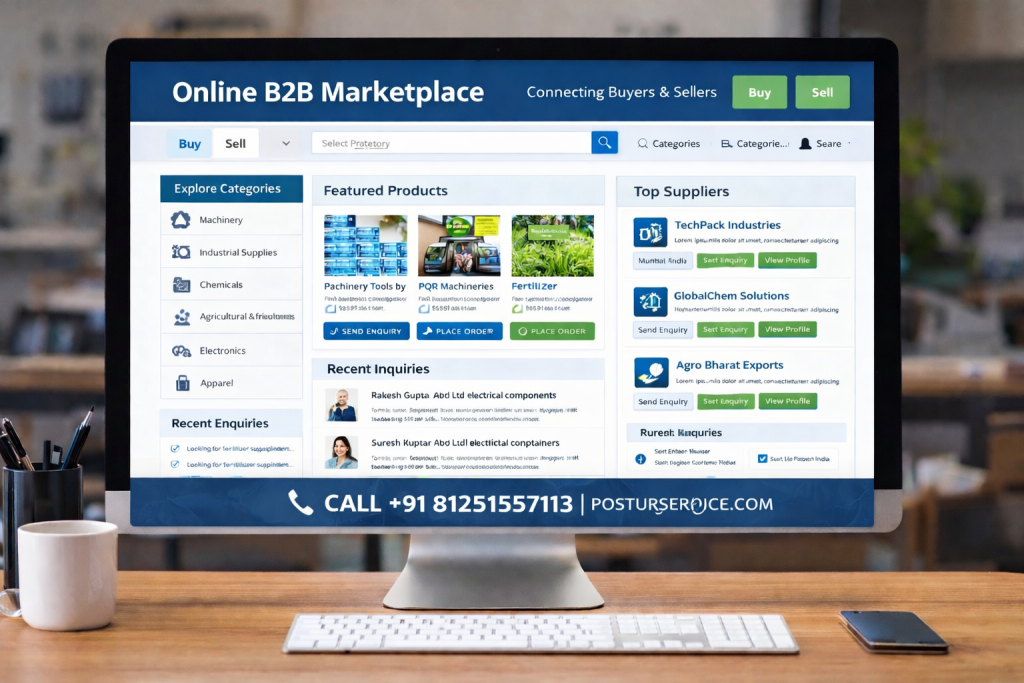
So a B2B classified website connects companies, wholesalers, traders, manufacturers, distributors, service providers, and agencies with each other. Online B2B marketplace.
What is a Classified Website?
A classified website is an online platform where people or businesses can post ads (called “classifieds”) to:
- Sell products
- Offer services
- Announce requirements (like “Wanted: 1000 kg of iron scrap”)
You’ve probably seen classified sites for jobs, used mobiles, cars, real estate, etc. A B2B classified site is the same concept, but focused only on business needs. Buy and sell business services online.
.
How B2B Classifieds are Different from B2C Classifieds
Here’s the key difference:
| Aspect | B2B Classified Website | B2C Classified Website |
|---|---|---|
| Target audience | Businesses, manufacturers, traders | General public, individual buyers |
| Order size | Bulk, wholesale | Single or small quantity |
| Purpose | Long-term business relations, wholesale | One-time or personal use purchases |
| Examples | Industrial machines, raw materials | Used phones, bikes, rental houses |
So, B2B classifieds are more serious, more professional, and often involve bigger transactions and long-term deals.
Core Features of a B2B Classified Website
To understand how it works, you need to know its main building blocks.
User Registration and Business Profiles
Businesses sign up and create accounts as:
- Manufacturer
- Trader
- Wholesaler
- Service provider
- Distributor or agent
They fill:
- Company name, address, website
- Business category (e.g., electronics, textiles, machinery)
- Contact details
- Description of what they buy/sell
This becomes their business profile, similar to a mini-website inside the platform. Manufacturers and suppliers directory.
.
Categories and Subcategories for Listings B2B Classified Website
To keep everything organized, the website is divided into categories like:
- Machinery & Equipment
- Chemicals
- Construction Materials
- IT & Software Services
- Packaging & Printing
- Agriculture & Food
Each category has subcategories so buyers can quickly find what they need. Wholesale business classifieds.
Product and Service Listings (Ads) B2B Classified Website
This is the heart of a B2B classified website.
A listing (ad) usually includes:
- Product or service title
- Category
- Detailed description
- Minimum order quantity (MOQ)
- Price or “Price on Request”
- Images, brochures, or PDFs
- Location
- Contact or enquiry button
Each ad is like a small digital salesperson working 24/7. Service provider listings for businesses.
Search, Filters, and Advanced Search Options B2B Classified Website
Because there can be thousands of listings, the platform offers:
- Keyword search (e.g., “PVC pipes manufacturer in Gujarat”)
- Filters for:
- Location
- Category
- Price range
- Supplier type (manufacturer, trader, etc.)
This helps buyers find exactly what they need without wasting time. B2B product and service marketplace.
Contact Options: Enquiry Forms, Chat, and Phone B2B Classified Website
When a buyer finds a suitable listing, they can:
- Click “Send Enquiry”
- Start chat (if enabled)
- Call or WhatsApp (if details are visible)
The website usually sends an email or dashboard notification to the seller with buyer details and requirements.
How a B2B Classified Website Works – Step-by-Step Process
Let’s look at the entire journey from both sides.
Step 1: Sign Up and Create a Business Account
First, a business:
- Registers on the site
- Verifies email/phone
- Completes its business profile
Some platforms verify documents to build more trust.
Step 2: Post a Listing (Ad) – Products or Services
The seller (or service provider):
- Chooses a category
- Writes a title (e.g., “Bulk Supplier of Organic Spices”)
- Adds description, specs, MOQ, and images
- Sets whether it’s a sell offer, buy requirement, or service
The listing is then published and visible to others.
Step 3: Buyers Search and Discover Listings B2B Classified Website
Buyers visit the site to:
- Search for products like “HDPE bags”, “CNC machine”, “digital marketing services”, etc.
- Filter results based on their needs
They compare multiple listings and profiles before selecting potential suppliers.
Step 4: Buyer Sends Enquiry or Contact Request B2B Classified Website
Once interested, the buyer:
- Clicks “Contact Supplier” or “Get Best Quote”
- Fills a short form:
- Quantity required
- Delivery location
- Budget (optional)
- Any specific requirement
This enquiry goes to the relevant seller(s).
Step 5: Seller Responds and Negotiates B2B Classified Website
The seller receives:
- Buyer’s contact info
- Product requirement details
Then they:
- Reply via email, phone, or in-built messaging
- Share price, samples, offers, and terms
- Negotiate quantity, delivery, payment terms, etc.
This part usually happens outside the platform in detail.
Step 6: Deal Finalization Outside the Platform B2B Classified Website
Most B2B classified websites are lead generation platforms, not full ecommerce websites.
That means:
- They connect buyer and seller
- They do not always handle payment, logistics, or contracts
The actual order, invoicing, and shipping are usually handled directly between businesses.
Types of B2B Classified Listings
Not all ads are “We sell this.” There are different types.
Buy Leads (Wanted Ads)
Businesses also post:
- “We want to buy 10 tons of steel scrap”
- “Looking for packaging supplier for cosmetic products”
These are called buy leads or wanted ads, and they attract sellers who can fulfill the requirement.
Sell Listings (Offer Ads)
These are traditional ads where:
- The business is offering something
- Others can enquire about it
Example: “Ready stock of industrial pumps available.”
Service-Based Listings
Not only products, but services too:
- Logistics, shipping, warehousing
- IT services, software development
- Digital marketing for B2B brands
- Machinery repair and maintenance
These businesses use B2B classifieds to get long-term corporate clients.
Distributorship and Franchise Listings
Some businesses post:
- “Looking for distributors in South India”
- “Franchise opportunity available for our brand”
This helps them expand into new regions through B2B partnerships.
Revenue Models of a B2B Classified Website
How does the platform itself make money?
Free vs Paid Listings
- Basic listing may be free
- Advanced features like:
- More images
- Priority display
- Extra categories
- More enquiries per month
…are available in paid plans.
Featured / Premium Ads
Some listings appear:
- On the homepage
- On top of category pages
- Marked as “Featured” or “Premium”
Businesses pay extra to get more visibility and clicks.
Subscription Plans for Businesses
Many platforms sell membership plans, where you get:
- Higher visibility
- Access to verified leads
- Better ranking in search results
- Extra tools like CRM or analytics
These are usually monthly or yearly.
Lead Selling and Commission-Based Models
Some B2B classified websites:
- Collect multiple buyer enquiries
- Share them with sellers who pay per lead
- Or charge a small commission if a deal is closed (less common in pure classifieds)
Display Ads and Third-Party Advertisements
They may also show:
- Google Ads
- Banner ads for other companies
- Sponsored content or promoted posts
All of these become extra revenue streams.
Key Benefits of B2B Classified Websites for Businesses
Why should a business use them?
Wider Reach and More Visibility
Without big marketing spend, your business can:
- Be visible to buyers across your city, state, country, or even globally
- Show up in search results when buyers search for products like yours
Cost-Effective Lead Generation
Compared to:
- Trade shows
- Offline distributors
- Cold calling
…B2B classifieds can provide consistent enquiries at a lower cost.
24/7 Online Presence for SMEs and Manufacturers
Small manufacturers and traders who don’t have a proper website can still:
- Create a business profile
- Showcase products and services
- Get leads 24/7 without any tech knowledge
Faster B2B Networking and Partnerships
You can use B2B classifieds to:
- Find suppliers
- Find distributors
- Find franchise owners
- Find outsourcing partners
It compresses months of offline networking into a few clicks. Post free B2B classified ad.
Important Features for a Successful B2B Classified Platform
If you are planning to build or analyze such a website, these are crucial.
Trust and Verification Systems
Business users need trust.
Good platforms provide:
- Verified badges
- KYC or document verification
- Trade assurance (in some cases)
This helps attract serious buyers and sellers.
Reviews, Ratings, and Testimonials
- Ratings from past buyers
- Reviews about product quality and service
These help new buyers decide whom to trust. Find suppliers and vendors online.
Secure Messaging and Lead Management
For sellers, having a proper lead management system is very helpful:
- All enquiries at one place
- Message history
- Follow-up reminders
This turns the platform into a mini-CRM for B2B sales. Generate business leads online.
SEO-Optimized Listing Pages
Each listing should be:
- Search-engine friendly
- Have proper keywords, meta tags, and URL structure
This helps the platform (and the individual listings) rank in Google search, bringing more organic traffic.
Mobile-Friendly and App Support
Most users browse on mobile, so:
- Responsive design
- Fast-loading pages
- Mobile app (if possible)
…make a big difference in user experience and lead generation. Promote business services digitally.
How B2B Classified Website Attract Traffic and Users
A good platform doesn’t just wait for people to magically appear. It markets itself too.
SEO and Organic Traffic
The website targets keywords like:
- “B2B suppliers of ”
- “Wholesale manufacturers”
- “Bulk buyers/sellers”
With proper SEO, thousands of buyers and sellers arrive for free from search engines. Connect buyers and sellers B2B.
Content Marketing and Blogs
Helpful content like:
- “How to choose the right packaging supplier”
- “Top 10 industrial machine manufacturers”
…brings in relevant B2B visitors and builds authority.
Social Media Promotion and Communities
They may run:
- LinkedIn pages
- Facebook groups
- WhatsApp or Telegram communities
These act as lead magnets and nurture networks.
Email Marketing and Lead Nurturing
B2B platforms often send:
- New lead notifications
- Product or category highlight emails
- Promotional offers on premium plans
This keeps users active and engaged.
Common Challenges in Running a B2B Classified Website
It’s not all smooth and easy.
Fake Leads and Low-Quality Listings
Some users may:
- Post fake requirements
- Share incomplete or misleading information
This reduces trust and must be controlled with checks and moderation.
Competition with Big Marketplaces
Big players like global B2B marketplaces already exist.
So, a new B2B classified website must:
- Focus on a niche
- Offer better local support
- Provide unique value like region-specific listings or language support
User Trust and Verification Issues
Without verification, buyers may fear:
- Fraud
- Poor quality
- Non-delivery
That’s why verification and rating systems are essential.
Maintaining Listing Quality and Relevance
Old or expired ads make the site look outdated.
So platforms must:
- Regularly remove expired listings
- Ask users to renew or update ads
- Filter spam and duplicate content
Tips for Businesses to Use B2B Classified Website Effectively
If you’re a seller or service provider, here’s how to win more business from B2B classifieds.
Optimize Your Listings for Search
- Use keywords buyers actually type (e.g., “bulk rice supplier”, “LED light manufacturer”)
- Mention product specifications clearly
- Add location in the title or description if relevant
Use High-Quality Images and Clear Descriptions
Treat your listing like your product’s first impression.
- Use clear product photos
- Add brochures or catalogs if possible
- Explain benefits, not just features
Respond to Enquiries Quickly
In B2B, buyers often contact multiple suppliers.
- Faster response = higher chance of closing the deal
- Use email + phone + WhatsApp (if allowed)
- Be professional and clear with pricing and terms
Use Multiple Platforms for Better Reach
Don’t depend on just one B2B classified website.
- List your business on multiple portals
- Track which one gives better leads
- Invest more in platforms that give you ROI
Future of B2B Classified Websites
The game is evolving.
AI, Automation, and Smart Matching
In future (and even now on some portals):
- AI will match buyers and sellers automatically
- Recommended suppliers and products will appear like “You may also like” sections
This saves time for both sides.
Integrated Payments and Escrow Services
Some B2B platforms are slowly moving from:
- Just lead generation
To:
- Secure online payments
- Escrow services for safer transactions
- Integrated logistics and shipping solutions
Global Trade and Cross-Border B2B Classified Website
B2B classifieds are gradually becoming global trade hubs.
- A small manufacturer can reach foreign buyers
- Export and import opportunities increase
- Platforms may offer tools like currency conversion, shipping help, and compliance info
Conclusion
A B2B classified website is a powerful digital tool that connects business buyers and sellers through simple online listings. It acts as a modern version of the old “business yellow pages + trade magazine classifieds,” but with search, filters, instant enquiries, and global reach.
Instead of building a huge eCommerce store with complex systems, many companies use B2B classified platforms to:
- Get regular leads
- Find new suppliers or distributors
- Build long-term B2B relationships
Whether you’re a manufacturer, trader, service provider, or distributor, using B2B classified websites smartly can give you:
- More visibility
- Better-quality enquiries
- Faster growth with less marketing cost
And if you’re thinking of starting your own B2B classified website, you now understand how it works, how it earns, and what features really matter.
FAQs About B2B Classified Website
FAQ 1: What is a B2B classified website in simple words?
A B2B classified website is an online platform where businesses post ads to buy or sell products and services to other businesses. It connects manufacturers, wholesalers, traders, and service providers with potential business clients.
FAQ 2: How do B2B classified website make money?
They earn by:
- Selling premium or featured listings
- Offering paid membership or subscription plans
- Charging per lead in some cases
- Showing display ads and sponsored promotions
Most of them follow a freemium model – basic listing is free, advanced visibility is paid.
FAQ 3: Is a B2B classified website the same as an eCommerce site?
Not exactly.
A B2B classified site mainly generates leads by connecting buyers and sellers.
An eCommerce site usually handles:
- Add to cart
- Online payment
- Order tracking
Most B2B classified platforms do not complete the full transaction; they just help initiate it.
FAQ 4: Can small businesses benefit from B2B classified website?
Absolutely. Small and medium businesses can:
- Get visibility without building their own website
- Reach buyers in new regions
- Receive enquiries directly from serious B2B buyers
It’s one of the most budget-friendly ways for SMEs to do online marketing.
FAQ 5: How can I start my own B2B classified website?
To start one, you need to:
- Choose a niche or industry (or go multi-category)
- Use a classified website script, CMS, or custom development
- Add features like registration, listings, search, enquiry forms, and admin panel
- Plan SEO, content, and digital marketing to attract users
- Offer both free and premium plans to grow revenue
Over time, focus on trust, verification, and quality leads to stand out from competitors.
Leave a Reply